The Relentless Reflective Learning Model™ is a K–12 classroom system. Students set their own goals, reflect on their own work every Friday, and then sit down and explain it — in their own words — to the people who matter to them.
Why would a conference about a student be held where the student isn’t reporting their own progress?
Think about what that teaches. A child sits in a chair while two adults discuss their work, their effort, and their behavior — as though the child were a topic rather than a person.
We are teaching submissive learning.
So I flipped it. I put students in charge of planning, writing, and leading their own conferences. Everything changed.
Students choose one piece of their own work each week and answer the same three questions — from kindergarten through senior year.
Not the neatest paper. The one they have something true to say about — often the one they got wrong and then fixed.
They point at the evidence. Not “I’m good at math” — the exact part of the page that proves it.
A named strategy with a dose attached. “Try harder” is a wish. “Check my subtraction before I turn it in” is a plan.
The questions never change. Only the depth of the answer does.
Students take goal setting seriously because they know that at the end of nine weeks, they are going to give account.
Students set quarterly goals for academics and behavior, chosen from menus organized by subject, each with a stated measure of success.
Thirty minutes each Friday. One piece of work, one reflection, and a strategy chosen to help them grow. Students track their own follow-through.
Did I accomplish it? How, or why not? What got in my way, and what changes next quarter?
The student presents their work, explains their own grades and behavior, and shares their plan. The teacher is right there, backing the student up.
This was built one classroom at a time — in years with a supportive team and in years without one, in schools with money and schools without any.
I always kept my administrators informed, and they were generally supportive. They just weren’t going to require it of anyone else. That was fine. It worked anyway, and the results did the persuading.
You can move your students from passive to self-driven while the rest of the building decides.
Same three questions, same artifact, same routine — different amounts of scaffolding. Students on IEPs and students learning English do the identical activity as everyone else, not a parallel one.
Grade-level written response, citing evidence from the student’s own work.
Sentence frames and an academic word bank, for students whose thinking is there but whose writing is the barrier.
Picture or choice response. Oral answers accepted, scribe permitted, home language welcome.
Print-ready PDFs. No platform, no subscription, and no internet required to run it. Every purchase below is a single teacher license, for the students you serve.
Each includes the Goal & Accountability Set and a Start Here guide.
A 33-page evidence brief covering eight claims — each rated Strong, Good, or Mixed — with a logic model, ESSA tier positioning, and a pilot measurement plan.
It says plainly where the evidence is early-stage and where family engagement research is mixed, because a district reviewer will find that out anyway and it is better coming from us.
Each with its evidence standing stated honestly, and four limits named up front.
A well-specified logic model built on high-quality research, with a stated pathway to Tier III through a single pilot. We will not tell you this is Tier I. It is not.
What to measure in one quarter, and what it would take to move up a tier. The instrument is already inside the Conference Kit.
For maximum effect, school-wide adoption is highly recommended. District-wide is even better.
Your students learn to explain their own work. It runs inside your own schedule, with no rollout required.
Every teacher asks the same three questions. Students carry the routine up a grade instead of starting over, and families come to expect it.
A student who sets goals and gives account from kindergarten through graduation doesn’t learn a strategy. They become a different kind of learner.
If your school or district is ready to level up student ownership and empower students and families, reach out. School site and district licensing, on-site professional development, and implementation support are all available.
jody@believetechnologies.com · Purchase orders welcome
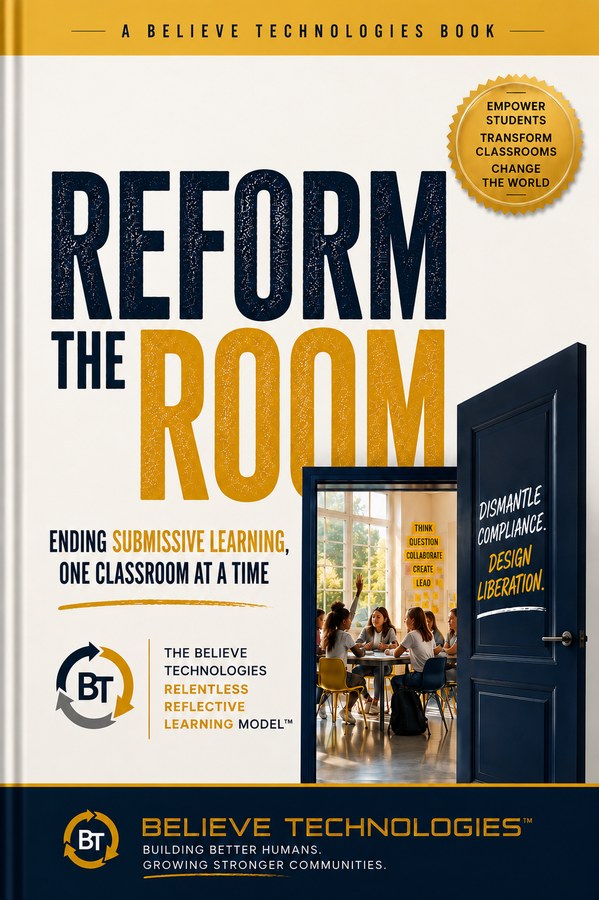
Ending Submissive Learning, One Classroom at a Time
Submissive learning is the systematic training of children to be passive in their own education — to receive instead of reach, to comply instead of own, to wait to be told instead of learning how to decide. It hides inside good teaching, which is exactly why almost no one names it.
This book names it, traces how a hundred ordinary practices teach it, and shows the routine that ends it. It includes a chapter on where the evidence is genuinely thin — because a district reviewer will find that out anyway, and it is better coming from us.
You do not need the materials on this page to run the model. The method is in the book.
Paperback and Kindle · Jody Pearson · Believe Technologies
The three questions, the nine-week arc, and how to start this Friday with one piece of work and nothing else.
Why ownership cannot be mandated into existence, and what a principal can actually do instead.
Why future teachers teach the way they were taught — and what that means for every education program.
I spent 20+ years in education across Michigan, South Carolina, and Florida — as a classroom teacher, reading specialist, media specialist, and assistant principal. I ran this in my own classrooms throughout those years.
I started it my first year teaching, and it made me feel like a real teacher. Not because my students behaved, but because I could see they knew the material well enough to reflect on it, judge their own progress, and build a specific plan to get better.
What I loved most was knowing I was giving students practice in learning how to learn. Because if they know how to learn, they can be successful at anything they want.
That is higher-level learning. That is an empowered student. Those are the seeds of lifelong learning.
Jody Pearson · Master’s degrees in Reading, Educational Leadership, and Educational Media & Technology